Most peanut projects don't fail on press tonnage — they fail on feed, route, and aflatoxin control
Before comparing a 300-ton against a 500-ton hydraulic press, lock three things: feed form (pods or kernels), route (hot 80-100°C or cold ≤60°C), and aflatoxin discipline (B1 <20 μg/kg). This guide walks the full peanut line on real parameters.
A peanut hydraulic oil press process guide built on real numbers: kernel oil 44-56%, hot press 80-100°C (yield 40-48%), cold press ≤60°C (yield 35-42%), aflatoxin B1 <20 μg/kg, batch 100 kg/barrel, 200-300 mesh filtration.
Feed condition
Pods, shelled kernels, and graded kernels carry different preparation, cleaning, and handling assumptions.
Pressing route
Hot pressing needs a clear roasting window and loading rhythm; lower-temperature positioning needs cleaner kernels and tighter post-press handling.
Post-press handoff
Crude oil may move to pneumatic filtration, settling, buffer storage, or later refining, while cake handling should be planned beside the press.
Peanut shelling and cleaning before pressing
Use this clip to confirm whether shelling and cleaning belong in the current phase before sizing the press room.
 Process path
Feed, pressing, filtration, and peanut cake in one route
Keep pods or kernels, hot or lower-temperature route, crude-oil filtration, and cake flow on one project path.
Decide first
Pick the route before the machine — here's the quick read
The hot route and cold route are not two settings on one machine. They use different press classes, run different cycle times, and serve different markets. Choose the lane first.
Bulk edible oil → Hot route
Roast 160-180°C, press 80-100°C on a 300-325 ton hydraulic press. Oil yield 40-48%, residual oil 6-8%, cycle 30-40 min per 100 kg barrel. Highest throughput per hour.
Premium bottled brand → Cold route
Press at ≤60°C on a 355-500 ton hydraulic press. Oil yield 35-42%, residual oil 8-10%, cycle 60-90 min per barrel. Unrefined smoke point ~160°C — premium positioning, lower throughput.
Still have pods? → Shelling first
Shells are 30-40% of pod weight and contain no oil. Hydraulic pressing works only on shelled kernels. If you start from pods, shelling and a shell-disposal plan must be in scope.
Step by step
The peanut line from raw material to filtered crude oil
1 · Shell, clean, and grade
Remove stones, metal, and stalks. Shell pods (shell 30-40% of weight). Grade kernels by size for uniform pressing. Reject moldy or damaged kernels — aflatoxin concentrates in damaged tissue.
2 · Set moisture to 5-8%
Optimal pressing moisture is 5-8%. Above 10% causes low yield and mold risk; below 4% causes excessive friction and brittle cake. Test moisture every batch.
3 · Roast (hot) or warm gently (cold)
Hot route: roast 160-180°C in flat-bottomed woks or drum roasters until moisture drops to 3-5% and color turns golden. Cold route: warm ≤60°C or crush at ambient. Record roast temperature per batch.
4 · Load the hydraulic press by a fixed rule
Standard barrel 390 × 800 mm holds ~100 kg; model 325 uses 14 partitions. Hot cycle 30-40 min, cold cycle 60-90 min. System pressure 60 MPa, 2.2 kW motor — the same hydraulics across the range; only frame strength and pressure stability differ.
5 · Filter crude oil immediately
Plate-frame filtration at 200-300 mesh right after pressing. Crude oil clarity target: sediment ≤0.1%, moisture ≤0.2%. Filtering warm oil promptly avoids sediment settling and flavor drift.
Key parameters
Real peanut numbers to size the line
Every figure below comes from the production spec, not a generic catalog. Use them to sanity-check any quote.
Avoid rework
Mistakes the press gets blamed for — but that belong upstream
Hot peanut roasting and hydraulic pressing rhythm
Watch the roast-to-press handoff and barrel loading rhythm that decides real hourly output.
- Skipping aflatoxin testing: one contaminated batch can destroy an entire export shipment. Color sorter or manual picking is not optional for food-grade oil.
- Mixed kernel size and drifting moisture: the press is blamed for low yield that actually comes from inconsistent feed.
- Using cold-press claims for hot-route oil: hot-pressed oil is fragrant and practical, but it is not cold-pressed — mislabeling risks brand and compliance problems.
- Sizing only the press: shelling, roasting, filtration, and cake handling must match its throughput, or the press sits idle waiting on a bottleneck elsewhere.
Strong front-end preparation and aflatoxin control remove most arguments about machine size that are really feedstock problems.
Why hydraulic
Why a hydraulic press suits peanut oil — and what stays constant across the range
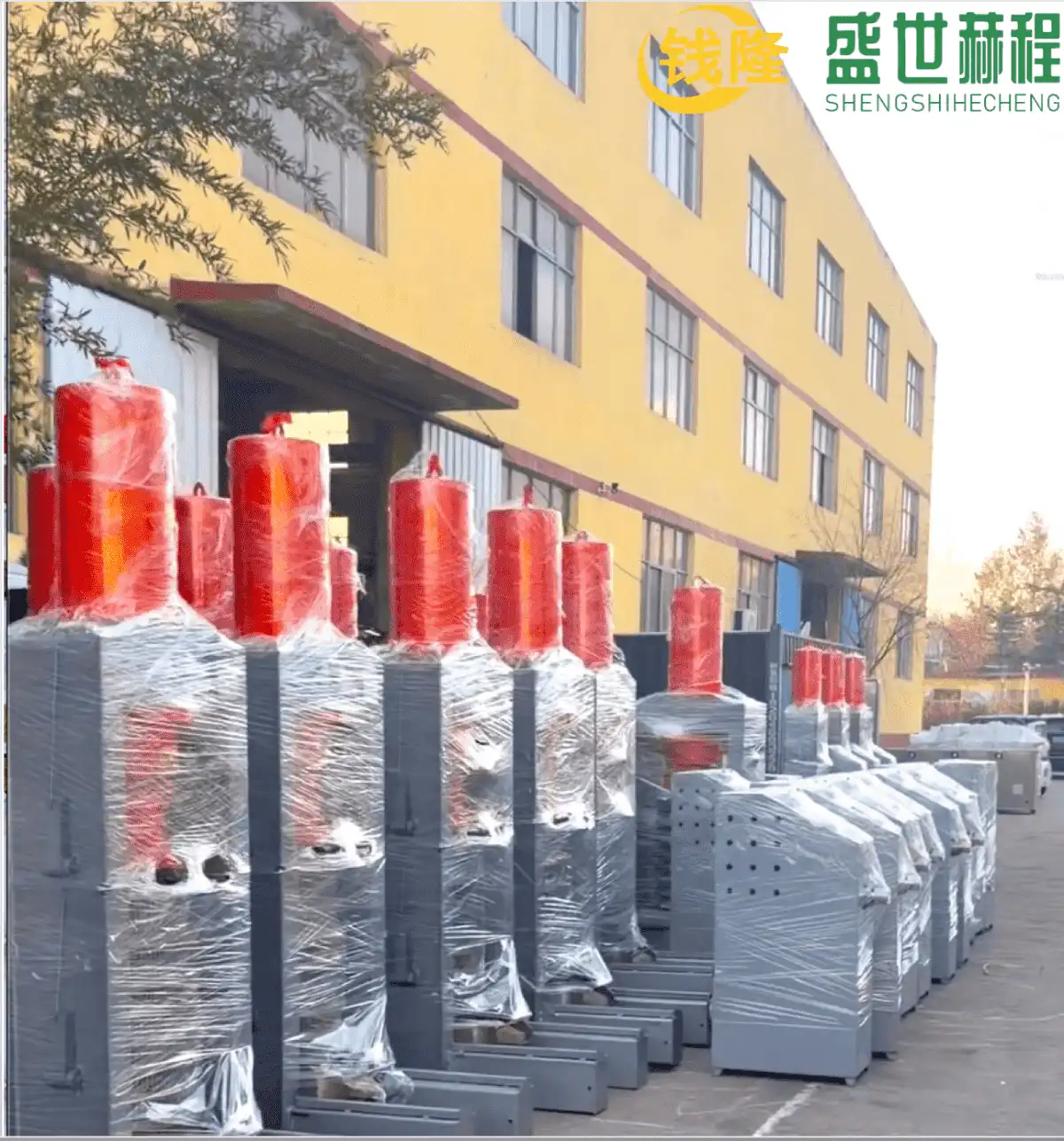
Peanut kernels are soft, high-oil (44-56%) seeds that release oil readily under steady pressure, which is exactly what a hydraulic press delivers: a slow, even squeeze that protects flavor instead of the high-shear heat of a screw press. Across the peanut oil line team range — model 300, 325, 355, and up to 500 — the hydraulic system is the same: 60 MPa system pressure driven by a 2.2 kW motor, mechanical high- and low-pressure relief valves (not solenoid valves), carbon-steel partition plates between cakes (not filter cloth), and twin pressure gauges whose needles should always read together. What changes between models is frame strength and pressure stability, not the core hydraulics. That is why the model choice follows the route, not the other way around: a 300-325 ton frame is matched to the faster, lower-pressure hot cycle (30-40 min, 80-100°C), while a 355-500 ton frame absorbs the higher mechanical stress of the cold cycle (60-90 min, ≤60°C) without deforming over years of use. A correctly sized press keeps its frame true, holds pressure steady, presses out more oil, and lasts longer — the four things that actually decide cost per ton of oil. Picking a bigger model than the route needs wastes capital; picking a smaller one than the cold route demands shortens its life.
Project boundary
What to confirm before scoping Peanut Oil Press Process Guide: Hot vs Cold Route, Yields, and Real Parameters
Peanut Oil Press Process Guide: Hot vs Cold Route, Yields, and Real Parameters should not be quoted from an equipment name alone. Check feed lots, target oil, post-press handling, and packing rhythm in one scope before deciding which Peanut Oil Press modules stay. Listed on the factory hot-press page — discuss 300/325 first.
When feed condition, moisture, impurities, batch weight, and product position are unclear, press tonnage and filter area become guesswork. Factory systems share 60 MPa and 2.2 kW motors; hot pure press is 30–40 min/barrel and cold pure press is ~2 h/barrel — cycle time matters more than brochure tonnage.
- Confirm whether feed is whole seed, kernels, pretreated material, or an existing semi-finished stream.
- Confirm whether the target is crude oil, filtered oil, bottled oil, drum ingredient oil, or a refining handoff.
- Hot cycle reference: pure press 30-40 min/barrel, ~1.5 h for 2 barrels with loading; cold pure press ~2 h/barrel, ~4.5 h for 2 barrels.
- Confirm batch rhythm, labor, changeover, retained samples, power (often 380V/50Hz/3ph), and site install conditions.
Factory model check
Match hot / cold models to factory hard data
When discussing Peanut Oil Press Process Guide: Hot vs Cold Route, Yields, and Real Parameters, pin models to published factory specs — not tonnage alone.
Hot 300/325: 300–325 ton, 60 MPa system, standard barrel Ø390×800 mm / max 100 kg, pure press 30–40 min/barrel, ~1.5 h for 2 barrels with loading, 2.2 kW motor. Cold 355/400/426/480/500: 370–630 ton, integrated frame, same 100 kg standard barrel, pure press ~2 h/barrel, ~4.5 h for 2 barrels with loading; optional Ø300 high-pressure barrel max 60 kg. Residual oil target ~≤5% (peanut hot often 6–8% measured).
- Standard barrel Ø390×800 mm, max ~100 kg crushed feed; optional Ø300 high-pressure barrel max ~60 kg.
- Cylinder material 27SiMn; cold frames are integrated molded steel; hot frames are typically H-type channel steel.
- Listed on the factory hot-press page — discuss 300/325 first.
Equipment check
project scope needs to land in equipment interfaces
After Peanut Oil Press Process Guide: Hot vs Cold Route, Yields, and Real Parameters is clear, write the interfaces: how preparation feeds the press, how oil leaves the press, how filtration connects to tanks, and how packing receives finished oil.
Front-end input
Record feed form, daily volume, moisture, and sorting needs so pretreatment is not left to operators.
Filtration, tanks, and peanut cake
Define pneumatic/plate-frame filtration, tanks, retained samples, and cake offtake before press count. Factory hot lines often use multi-layer paper filters.
Delivery data
Prepare space, power (often 380V/50Hz/3ph), labor, target package, local rules, and acceptance method before quotation.
Questions to confirm next
Clear these up first
Yes. Shells are 30-40% of pod weight and contain no oil. Hydraulic pressing works only on shelled kernels. If you start from pods, shelling must be in scope, and the 30-40% shell by-product needs a fuel, fiberboard, or disposal plan sized to match press throughput.
Read this next
These next pages move the discussion forward
Buying guides
Hydraulic vs Screw Oil Press for peanut: Which Fits Your Mill?
Compare hydraulic batch press vs continuous screw (expeller) for peanut: oil quality, cold-press ability, capacity, residual oil, labor, and when each route wins. Use this before you request a quote.
Continue →Buying guides
peanut Hydraulic Press Capacity: Barrels per Shift and How Many Presses
Size peanut hydraulic capacity with real cycles: hot pure press 30-40 min/barrel (~1.5 h for 2 barrels with loading); cold ~2 h pure / ~4.5 h for 2 barrels. Example math for 1–5 t/day small mills.
Continue →Buying guides
peanut Oil Press Inquiry Checklist: Data That Gets a Real Quote
RFQ checklist for peanut hydraulic oil press projects: seed form, kg/shift, hot/cold, filtration, cake path, power, country, and photos. Incomplete inquiries get catalog replies — complete packs get model counts and line scope.
Continue →Send this page's requirement to the factory
Bring feed condition, target output, and site constraints, and we will continue from what this page covers.